
Continuing the theme of Margins, I am exploring borders. The first thing that comes to mind is a National Border, separating one country from another. You cannot cross from one country to another without a passport, visa, or required travel documents. The laws and rules that apply to one country or state may not apply in another.
The boundary or edge of that country may be the ocean, lake, or river, or it could be an arbitrary line drawn with latitudes and longitudes designated after wars or other international agreements. It could be a historical boundary that divided people of one tribe or group from another; it could also include a language boundary. Borders confine people to specific areas.
In examining this margin of Borders, we find the immigrants, refugees, and international workers. We find the systems and laws of the countries for immigration and emigration that make it easy or difficult for people to go across their chosen border. What are some reasons people want to leave the land of their birth or origin and live elsewhere?
TWO REASONS PEOPLE CROSS BORDERS

There are many and various reasons that people want to cross these borders, especially with a global economy, air travel, and people forming relationships across borders. But I want to address two main reasons that force people to cross borders. First, when people's basic needs for food, shelter, safety, and security are threatened, they will move to new pastures. For example, before there were political borders in Africa, the people were pastoral and nomadic; they moved on when the earth would no longer support their cattle and crops. The land could take care of them if they were free to roam. They moved to adjacent areas where they could maintain themselves, letting the veld recover before returning there at a future date. When people were no longer freely allowed to move to greener pastures and kept in designated areas, the veld could no longer sustain them. The new systems that were introduced kept them in designated areas, disrupting their whole pattern of living. In more modern times, famine, or locusts eating the crops, lack of currency for food imports when the food security of a country becomes dependent on Government or international aid. When corrupt systems prevent an economy from flourishing, the Government can no longer provide food for its citizens. To survive could entail moving out of their country to a place where they can provide for their families.

War has the same effect when people's lives are in danger and no longer feel safe. People will flee their countries and become refugees, hoping to find a better and safer life for their families. The war may not be named as such, but there are countries where the political or ethnic violence is so bad that people live in fear of their lives every day. The lack of employment opportunities as unemployment escalates in war-torn or politically unstable countries forces people to find work in other places to support their families. Immigration becomes a survival tactic to provide for one's basic needs.
The process for people to emigrate legally can be overwhelming for many people who are merely trying to survive. It is quite understandable that there need to be regulations to enter countries, yet the systems to process them can be complex and uncompassionate. The law has no compassion; it rules to create order.
WHAT ARE THE BARRIERS IMMIGRANT PEOPLE FACE CROSSING BORDERS?
After making this emotionally difficult transition to another country, immigrants face a new set of challenges. The language barrier is the most difficult to overcome. It takes time to learn new languages or even a new vocabulary to describe things in the same language with different nuances of meaning for a word. Not only does their different accent make them more difficult to understand, but they are immediately labeled as 'not from around here.' People are viewed with suspicion as they do not look or act like a local, and it takes a long time to build trust and relationships. Their education and qualifications may not be recognized in their host country, requiring them to re-qualify and obtain a recognized local degree. This may be too difficult to obtain for some people, and it reduces them to working jobs way below their skill level or capacity to survive. It takes a lot of time to adjust to a host country's new laws and regulations and know how the system works, obtain permits, benefits, or any other red tape. Bureaucracy is a giant to be fought all on its own.
THE FOUR BIGGEST CHALLENGES AFTER CROSSING THE BORDER
I chatted with a number of immigrants from different continents, asking them what their biggest challenges were and what would help them. These were a few of the things they told me they struggled with the most.
- Lack of identity in their new country and culture. Their circle of family and friends, contacts, and associates was disrupted, and they had to start at the bottom again to build friendship and contacts.
- Food! Without a doubt, this was high on the list. Many of the food they were used to, or traditional foods were unavailable or very expensive, and difficult to obtain in their new country.
- Family left behind. The heartbreak of leaving behind family and friends who did not qualify to emigrate to a new land. There is genuine grief and struggle at leaving elderly parents behind that they may never see again. I have chatted to an Uber driver who burst into tears on me while telling me her struggle at leaving her mother behind in Syria and not being able to visit or attend her sister's wedding. Another Uber driver told me his dilemma of leaving a wife, mother, and family in Afghanistan while trying to get his own visas and life sorted out before he could apply for them to come and join him. They felt abandoned by him and accused him of living the good life elsewhere. In truth, he was struggling to pay his own way here and send money back to them to survive over there. Many immigrants support their families back in their country of origin and work very hard to support themselves, working several jobs to survive.
- No Community Connections. This goes hand in hand with people being suspicious of newcomers to their community and not welcoming. It takes a very long time to break down the barriers of distrust for those in the margins.
HOW CAN WE BE JESUS TO THE PEOPLE FROM ACROSS BORDERS?
In the Old Testament, some laws protected foreigners, along with widows and orphans. "Do not oppress a foreigner; you yourselves know how it feels to be foreigners because you were foreigners in Egypt. (Exodus 23:9). I recently found out that the Hebrew meaning of Egypt is 'confinement and limitation.' That meaning certainly describes what it is like to live in the margins as an immigrant! To help an immigrant is to make them feel welcome and included, not just confined to their kind, although that is also important for them to have a community with whom they can truly relate.
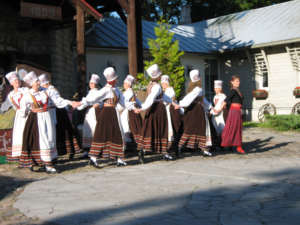
We can help them by providing hospitality and opportunities to participate. We can invite them to share their culture and stories with international evenings. Allow them to host with their traditional foods and feel at liberty to wear their national dress. The diversity and color they bring can undoubtedly be a blessing and help create a more inclusive culture.
We can be like Jesus by having compassion. He showed compassion for the Samaritan woman and interacted with other Gentiles, even though Jews did not mix with Gentiles. Listen to people; they may be struggling, you may have no idea how hard it is for them to survive. Don't judge them for why they left their country of origin and families, be compassionate in supporting them by hearing them. Point them in the right direction if they are struggling with red tape. There may be nothing practical you can do to help but make time to be a friend and listen, show them you care. See them as people made in God's image.
"This is what the Lord says: "Maintain justice and do what is right, for my salvation is close at hand, and my righteousness will soon be revealed. Blessed is the one who does this— the person who holds it fast, who keeps the Sabbath without desecrating it, and keeps their hands from doing any evil." Let no foreigner who is bound to the Lord say, "The Lord will surely exclude me from his people." And let no eunuch complain, "I am only a dry tree." Isaiah 56:3.
By having shared my exploration of the margin of borders, I hope you will have gained a new perspective of the immigrant people who live in that space. Your new understanding will help them transition into their new place of abode and feel at home while retaining their identity, not only as human beings but also made in God's image and worthy of love and acceptance.


0 Comments