BEACHES -THE LIFEGUARDS SIT IN THE MARGINS

By Deryn

Nov 23, 2022

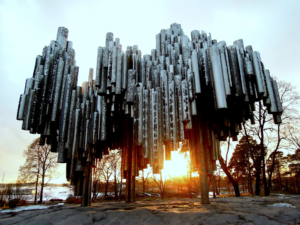
Sibelius monumnet Helsinki showing organ pipes that are tree trunks of the forest

Photo Pixabay, Sibelious Monument,

Music becomes a voice for change

I have long believed that the arts serve purposes far beyond decoration. A painting can tell a story. A poem can preserve a memory. A novel can give a forgotten person a voice. Drama and dance are transient vehicles for storytelling. And music? Music can bring people together.  have seen something of this for myself in my travels. I have stood before the monument to Jean Sibelius in Helsinki, Finland, and I have visited Estonia. Standing in those places, knowing something of their history, gives a different meaning to the music. You begin to understand that these were not simply composers writing beautiful melodies. In times of oppression and uncertainty, music can become a vessel carrying the identity of an entire people.

Music when a nation finds its voice

Consider Finland. For more than six hundred years, Finland was part of the Swedish realm. In 1809, it passed from Sweden to the Russian Empire and became an autonomous Grand Duchy. During the nineteenth century, a growing Finnish cultural movement sought to strengthen a distinct national identity. The Kalevala compiled from Finnish oral poetry, became an important expression of that identity. Artists, writers, and musicians began to give Finland a language of its own, not necessarily a political language, but a cultural one.

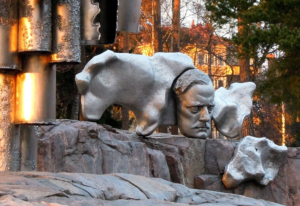
Sculpture of Sibelious Head, Helsinki

Photo Pixabay, Sibelious Monument

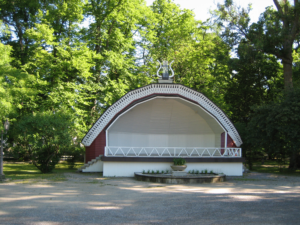
Then came Sibelius. In 1899, during a period of increasing Russian pressure and attempts at Russification, Sibelius composed the music that would become Finlandia It was originally part of a series of historical tableaux presented at the Press Celebrations in Helsinki. The final section, known as “Finland Awakes,” stirred something deep in the Finnish people. Finlandia became a symbol of Finnish nationalism. When I stood before the Sibelius monument, I wasn’t just viewing a memorial to a famous composer. It reminded me of what happens when art helps people remember their identity. Sibelius helped give Finland a sound, and sometimes people need a sound before finding a voice. Organ pipes represented the trees of the forest; forests go deep into the psyche of the Finnish people, a voice that resonated with them.Estonian Music Festival Stand

Estonia sang its way toward freedom

I experienced a similar feeling when I visited Estonia. Domination by powerful neighbors has marked Estonia’s history, and during the Soviet period, language and national identity were under pressure. Yet Estonia had an extraordinary cultural treasure: its singing tradition.

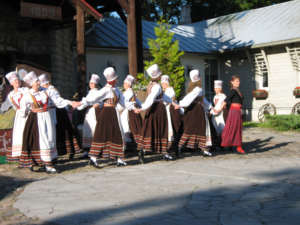
The Singing Revolution of the late 1980s demonstrated just how powerful that treasure could become. Hundreds of thousands of Estonians gathered at the Tallinn Song Festival Grounds and sang traditional and patriotic songs together. They sang Mu isamaa on minu arm, “Land of My Fathers, Land that I Love,” a song that had become deeply associated with Estonian identity. They also sang the patriotic songs of composer Alo Mattiisen.Music of Estonian Dancers

Estonian Folk Dancers, Video - Deryn van der Tang

This was nonviolence; they were not taking up arms, they were raising their voices. By 1989, the movement had grown into the remarkable Baltic Way, when people in Estonia, Latvia, and Lithuania joined hands in a human chain stretching across the three Baltic countries. Music had helped people remember they belonged to something larger than the political system that governed them.

The music that defied ruins

Then there is Sarajevo. During the terrible siege of Sarajevo in the 1990s, cellist Vedran Smailović became known as the “Cellist of Sarajevo.” After twenty-two people were killed while waiting for bread, Smailović returned to the devastated area and played Albinoni’s Adagio in G minor in their memory. Picture a city under attack. Amidst the broken buildings and people living in fear, a man sits with his cello and plays. The music could not stop the bombs, nor could it bring the dead back. But it declared something profound:

Beauty had not been destroyed. Human dignity had not been destroyed, and the human spirit had not been destroyed. That is the power of the arts.

Why do the arts matter?

When we talk about social change, we often think about politicians, protesters, legislation, and movements. And, of course, these matter. But underneath every movement is something deeper: a story about who we are and what we believe is worth preserving. Artists help us tell that story. A composer can give a nation a melody. Poets can preserve a language. Painters can capture a landscape that becomes part of a people’s memory. A storyteller can take the ordinary life of one family and reveal something universal about courage, suffering, and hope.

Perhaps that is why oppressive regimes have so often tried to control language, literature, music, and art. They understand something we sometimes forget: culture holds memory. And memory gives people identity.

The Bible tells us, “A word fitly spoken is like apples of gold in pictures of silver” (Proverbs 25:11).

Sometimes someone speaks, paints, sings, or writes that word.

The arts may not change the world overnight. Yet, they have the power to shift how people view the world. And once people see differently, they may begin to think differently, hope differently, and eventually act differently.

As I think about Finland, Estonia, and many other places I have traveled, I remember that the arts form a vital part of human society. They are part of our inheritance; they carry the stories of those who came before us. They inspire courage in those struggling today and plant seeds of hope for future generations. Perhaps that is why music has such extraordinary power.

A single voice may be silenced, a single instrument broken, yet a song alive in people’s hearts proves much harder to destroy.

And sometimes, when a people begin to sing together, the world begins to listen.

Join the discussion and follow me on these networks!

Blouberg Beach - Unsplash Charle Fourie

I am coming to the end of this Series on Margins, which has been the theme for the year. I wanted to give a voice to those who have found themselves sidelined and pushed to the margins, mostly through circumstances and things they had no control over.

I wanted to thank each of the people who were willing to share their stories with me. They made themselves vulnerable to my readers sharing their hearts, hurts, and hopes. I hope their stories have given you a small insight into the things they deal with on a daily basis, and a measure of compassion for them. When I look at the teachings of Jesus and how many people, He helped out of the margins by giving them hope and healing. Like Blind Bartimaeus who cried at the edge of the road, “Jesus, Son of David, have mercy on me!” People tried to shut him down, but Jesus had mercy on him, called him, and healed him. The many women Jesus helped in their predicaments, He never once judged them, but listened and helped.

Beach where the water and earth meet

The Beach where sea and land meet Unshplash - Charle Fourie

Jesus is like the Lifeguard on the beach. Looking for people in distress so He can rescue and help them. To me, the beach is such a beautiful example of a margin. So I will share some thoughts about my favorite beach. Which beach is your favorite beach to walk along the shoreline?

Meditation on Blouberg Beach

When I lived in Cape Town, I would walk along the magnificent Blouberg or Melkbos beaches, where I could gaze across the bay at the iconic Table Mountain. I could see container ships moored in the bay waiting to enter the harbor. I listened to the surf as it beat upon the rocks, watching the rhythm of the waves as they rolled in and receded onto the beach. Sometimes there would be windsurfers riding with waves on their boards and parachutes. On a beautiful day, people sat under umbrellas on the beach; children made sandcastles and played on the water's edge under the watchful eyes of their parents.

I would love to walk along the high tide mark, looking for shells and other treasures amongst the smelly seaweed, plastic, and other debris thrown up by the waves. Often there would be seagulls picking their way through the debris as well.

Debris on the beach

Debris - Unshplash John Cameron

The beach is where the ocean's vastness stops, and the immensity of the landmass begins. This place is never static; there is always movement, with the tides coming in and out, the early morning beachcombers and evening lovers leaving their footprints in the sand.

Imagine Yourself Gazing on the Atlantic Ocean Across at Table Mountain

I often come to this beach in my imagination; it is my favorite place to contemplate and commune with God, sitting on a log thrown up in a winter storm years ago. As my thoughts for the year were to explore margins, I thought this was an excellent place to finish. What secret message does the beach hold for us? I gaze at the ocean; vast, scary, and untamable. I am not brave enough to swim or surf in those waves, besides the hidden dangers of the sharks. It is very deep, as the continental shelf drops off steeply. I trust the God who made the ocean to keep it in its bounds; there is nothing that this mere human can do to change a thing with the ocean, except to be a good steward of its fruit and keep it clean.

I look at Table Mountain, the massive sandstone mountain that originated 510 million years ago. I once climbed halfway up this mountain, it is also dangerous, and you need to be with someone experienced to climb it. The best way is to use the cable car. From the top of the mountain, you can see far into the distance where the ocean's vastness vanishes at the horizon, looking back into the continent of Africa, you see the ranges of the Cape Fold Mountains. I can do nothing to change the landmass; I need to trust God to keep it in place. I can only be a good steward of its fruits and keep the environment clean.

My Responsibilities

Here, sitting on the beach; I can make sandcastles and sift my fingers through the fine white sand. I can pick up the debris and put it in trash bags; I may even find some beautiful shells, smooth sea glass, or rock to collect. I can give the beach ball back to the child who lost it. I can chat with people. Maybe, I have a picnic I can share with someone, or meet up with friends on the beach. The beach is where the Lifeguards sit, making sure everyone is safe. The ice cream vendor and Food trucks sell their wares. This area between two things beyond my control is where I can make a difference.

How Do I See People?

Do I see people as the debris on the beach, tossed around like trash by life's waves? Or can I be a Lifeguard like Jesus, watching out for them? Do I see if they are getting out of depth, can I be a friend to share a meal, with the outcast, the 'other?' As I sit and talk these things over with Jesus, I think of what the Creator of the land and sea would have done. He sailed on the sea and walked on the beach at Galilea. He cooked a meal for his disciples and invited them to come and dine with him. He was generous with his presence and His hospitality.

I get up from my meditation on Blouberg beach with Jesus and muse; how can I help people in the margins of life? Their souls are treasures to be garnered for the Kingdom of God. I cannot change their circumstances or place, but I can look at them through the eye of Jesus as valuable souls. Jesus 'saw' people. I can befriend and offer hospitality to the 'other,' that most people walk by and consider as 'trash' or the debris of life.

CAN I BE A LIFEGUARD TO PEOPLE IN THE MARGINS?

Life uard

Lifeguard - Unsplash - John Cameron

Are there people you consider as ‘trash?’ How can you look at them differently? Imagine yourself having a conversation with Jesus on the beach. Let Him open your eyes to what He sees, and ask Him how you can be their Lifeguard.


I get up from my meditation on Blouberg beach with Jesus and muse; how can I help people in the margins of life? Their souls are treasures to be garnered for the Kingdom of God. I cannot change their circumstances or place, but I can look at them through the eye of Jesus as valuable souls. Jesus 'saw' people. I can befriend and offer hospitality to the 'other,' that most people walk by and consider as 'trash' or the debris of life.
Are there people you consider 'trash?' How can you look at them differently? Imagine yourself having a conversation with Jesus on the beach. Let Him open your eyes to what He sees, and ask Him how you can be their lifeguard.

0 Comments

Submit a Comment

Your email address will not be published. Required fields are marked *

Join the discussion and follow me on these networks!

More From Crossing My Bridges

Sibelius monumnet Helsinki showing organ pipes that are tree trunks of the forest

Music becomes a voice for change

A single voice may be silenced, a single instrument broken, yet a song alive in people’s hearts proves much harder to destroy.
And sometimes, when a people begin to sing together, the world listens.

read more...
Man in long grass with dog

THE STORIES OF ORDINARY PEOPLE

What ordinary people’s stories reveal is that true greatness is more than just being recognized. Sometimes it is measured simply by faithfulness in persevering day after day through the grind.

read more...

Pin It on Pinterest

Share This