Filling up My Creative Well in Margaret River

By Deryn

Jun 13, 2020

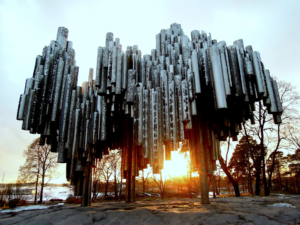
Sibelius monumnet Helsinki showing organ pipes that are tree trunks of the forest

Photo Pixabay, Sibelious Monument,

Music becomes a voice for change

I have long believed that the arts serve purposes far beyond decoration. A painting can tell a story. A poem can preserve a memory. A novel can give a forgotten person a voice. Drama and dance are transient vehicles for storytelling. And music? Music can bring people together.  have seen something of this for myself in my travels. I have stood before the monument to Jean Sibelius in Helsinki, Finland, and I have visited Estonia. Standing in those places, knowing something of their history, gives a different meaning to the music. You begin to understand that these were not simply composers writing beautiful melodies. In times of oppression and uncertainty, music can become a vessel carrying the identity of an entire people.

Music when a nation finds its voice

Consider Finland. For more than six hundred years, Finland was part of the Swedish realm. In 1809, it passed from Sweden to the Russian Empire and became an autonomous Grand Duchy. During the nineteenth century, a growing Finnish cultural movement sought to strengthen a distinct national identity. The Kalevala compiled from Finnish oral poetry, became an important expression of that identity. Artists, writers, and musicians began to give Finland a language of its own, not necessarily a political language, but a cultural one.

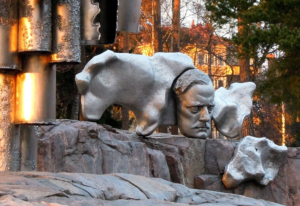
Sculpture of Sibelious Head, Helsinki

Photo Pixabay, Sibelious Monument

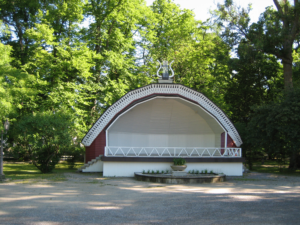
Then came Sibelius. In 1899, during a period of increasing Russian pressure and attempts at Russification, Sibelius composed the music that would become Finlandia It was originally part of a series of historical tableaux presented at the Press Celebrations in Helsinki. The final section, known as “Finland Awakes,” stirred something deep in the Finnish people. Finlandia became a symbol of Finnish nationalism. When I stood before the Sibelius monument, I wasn’t just viewing a memorial to a famous composer. It reminded me of what happens when art helps people remember their identity. Sibelius helped give Finland a sound, and sometimes people need a sound before finding a voice. Organ pipes represented the trees of the forest; forests go deep into the psyche of the Finnish people, a voice that resonated with them.Estonian Music Festival Stand

Estonia sang its way toward freedom

I experienced a similar feeling when I visited Estonia. Domination by powerful neighbors has marked Estonia’s history, and during the Soviet period, language and national identity were under pressure. Yet Estonia had an extraordinary cultural treasure: its singing tradition.

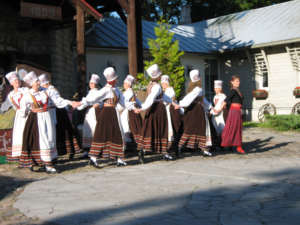
The Singing Revolution of the late 1980s demonstrated just how powerful that treasure could become. Hundreds of thousands of Estonians gathered at the Tallinn Song Festival Grounds and sang traditional and patriotic songs together. They sang Mu isamaa on minu arm, “Land of My Fathers, Land that I Love,” a song that had become deeply associated with Estonian identity. They also sang the patriotic songs of composer Alo Mattiisen.Music of Estonian Dancers

Estonian Folk Dancers, Video - Deryn van der Tang

This was nonviolence; they were not taking up arms, they were raising their voices. By 1989, the movement had grown into the remarkable Baltic Way, when people in Estonia, Latvia, and Lithuania joined hands in a human chain stretching across the three Baltic countries. Music had helped people remember they belonged to something larger than the political system that governed them.

The music that defied ruins

Then there is Sarajevo. During the terrible siege of Sarajevo in the 1990s, cellist Vedran Smailović became known as the “Cellist of Sarajevo.” After twenty-two people were killed while waiting for bread, Smailović returned to the devastated area and played Albinoni’s Adagio in G minor in their memory. Picture a city under attack. Amidst the broken buildings and people living in fear, a man sits with his cello and plays. The music could not stop the bombs, nor could it bring the dead back. But it declared something profound:

Beauty had not been destroyed. Human dignity had not been destroyed, and the human spirit had not been destroyed. That is the power of the arts.

Why do the arts matter?

When we talk about social change, we often think about politicians, protesters, legislation, and movements. And, of course, these matter. But underneath every movement is something deeper: a story about who we are and what we believe is worth preserving. Artists help us tell that story. A composer can give a nation a melody. Poets can preserve a language. Painters can capture a landscape that becomes part of a people’s memory. A storyteller can take the ordinary life of one family and reveal something universal about courage, suffering, and hope.

Perhaps that is why oppressive regimes have so often tried to control language, literature, music, and art. They understand something we sometimes forget: culture holds memory. And memory gives people identity.

The Bible tells us, “A word fitly spoken is like apples of gold in pictures of silver” (Proverbs 25:11).

Sometimes someone speaks, paints, sings, or writes that word.

The arts may not change the world overnight. Yet, they have the power to shift how people view the world. And once people see differently, they may begin to think differently, hope differently, and eventually act differently.

As I think about Finland, Estonia, and many other places I have traveled, I remember that the arts form a vital part of human society. They are part of our inheritance; they carry the stories of those who came before us. They inspire courage in those struggling today and plant seeds of hope for future generations. Perhaps that is why music has such extraordinary power.

A single voice may be silenced, a single instrument broken, yet a song alive in people’s hearts proves much harder to destroy.

And sometimes, when a people begin to sing together, the world begins to listen.

Join the discussion and follow me on these networks!

This is the second half of my trip to Western Australia, my hosts had planned the itinerary according to my love of nature and art. We often we travel with companions whose taste differs from ours, so what a treat to have friends who shared my interests and accommodated all my photo stops.

The following day we drive along a scenic route through the Margaret River Vineyards to the Chocolate Company.  I had never seen so much chocolate in my life, we watched them making these tasty treats and finished off experiencing the most exquisite Mocha coffee with chocolate buttons at the bottom which we had to stir to melt. It was too tempting to stay here much longer so we then took the Caves Road which took us to my host’s favorite place on earth, which he called Jerusalem Hollow, which is part of the Boranup Karri Forest in the Leeuwin-Naturaliste National Park. I could see why he enjoyed this so much it was a view to behold with the sunlight filtering through the leaves onto the trunks of these enormous Karri and Jarrah Trees, beautiful tall straight trees with mottled gold and grey bark, their wood is exceptionally hard and is quite often used for furniture and railway sleepers. In the days of sailing ships, they made good masts.

Jerusalem Hollow

We went up to the viewing point and appreciated this part of God’s creation, before heading on to the Boyanup Gallery where furniture and objects made from these woods was on exhibition, such beautiful grain in the polished surfaces of the wooden furniture. There were also paintings by local artists as well on Exhibition. We carried on back up the coast to Surfer’s Point and the Margaret River Mouth which was not as big as I had expected. Big surfing competitions are held in this area which had plenty of parking and view places for the competitors and supporters of the surfers. We saw someone skimming the waves on his orange surf kite, the wind was the strongest I had experienced in Australia at this point, so we sheltered in a very artistic shelter designed rather like a shell! 

Surfers Bay

Driving though Prevelly we saw the damage to the areas that had had fires two years before where several homes were lost, the vegetation had started to grow again, but the evidence of dead trees with their ghostly heads rising out of the carpet of green was a reminder and caution of the recent devastation of fires in Australia 

Cow Town

We drove into Margaret River town for lunch where we enjoyed a Subway Sandwich and then went for a taster at the Fudge Factory shop which we considered dessert, they had a large variety of fudges and nougat for sale. On the return drive home, we went through a place called Cowaramup “Cow Town”, this unique town that has 42 life-sized models of cows all around the town in different positions, grazing or sitting! I took some pictures to prove this! I am not sure how this came about. It is a wine growing area and in 2012 broke the Guiness World Record of largest gathering of people dressed as cows!

Kangaroos on the golf course

After a cup of tea at home, we walked to the local golf course to see the kangaroos, which had obviously made this their home, they were quite comfortable with us walking past them as they lay about the greens, bounding off when they were bored of watching us. Spooky fire burnt trees lined the golf course evidence of a fire in previous years as well.  

Canal Rock

The next day we drove to Canal Rock, a geological masterpiece of fault lines bisecting the rocks in two directions, leaving channels for the sea to flow through as the water crashes through the gaps.  A little wooden bridge crossed the channel to a viewing platform, this was a very special place for my hosts as their son had proposed to his girlfriend there.  They had put tea lights and rose petals along the bridge to lead her to the platform where their son went down on bended knee to propose – she accepted! We then drove down to Smith’s Beach which was a lovely Holiday Resort and caravan park, also with a nice surfing beach.  Our journey progressed to Yallinup where we looked at the town and then went to the Art Gallery which was quite extensive, with some lovely paintings and different styles. After lunch at home we walked into Dunsborough to look at the Christian Fletcher Gallery, a local nature photographer, with some amazing almost abstract photographs which had had put onto products. We competed the day at the Dunsborough Tavern, where I had a very nice meal of vegetarian hamburger.  

Bussleton Jetty

As all good things come to an end so did this wonderful artsy time away. We packed up and left Dunsborough behind us driving along the coastal road to Bussleton where we stopped and walked along the foreshore and Jetty.  The historical Jetty is 1.50 miles long and has a train that runs along its length so you can enjoy the ride and go out to see the corals. This was quite expensive and would take up a bit of time so we just went into the museum where we could enjoy looking at the history on an interactive map, which was really interesting. The Bussleton Iron Man Triathlons are held here and one can hire bikes if required, as there are many good cycle paths around the area, and the ocean around the jetty is where the swim takes place, with grandstands built into the beach for spectators. 

The jetty

After a coffee we walked along the esplanade for a bit licking our ice creams before setting off again back to Perth. We drove past the Vasse Estuary which was enormous with its cute settlement just outside of Bussleton. Then it was time to hit the highway again breaking our journey at the Miami Bakehouse with its award-winning pies, where I had the most delicious croissant. The gardens were decorated with brightly colored Art Kangaroos. We arrived back to Perth, and after a cup of tea we walked along the shore of the lagoon in the opposite direction to what we have previously done, enjoying the views of the marina and open water.    

Saturday morning, we took an early trip to Cottesloe Beach to see the Sculptures by the Sea Exhibition, Elizabeth Gilbert the author had been here the day before! We had an inspiring time looking at this extensive Exhibition with its large works of art placed along the beach and the jetty, some pieces were quite moving, especially one by an Iraqi artist symbolizing the freedom of relationships in Australia. My hosts had invited some of their family over in the afternoon where we had a good catch up chat on our life in Rhodesia and the good old days at the Geological Survey before my farewell dinner at the Bull Creek Chinese Restaurant. We had a delicious meal, I had my favorite Chicken and Cashew, they served such big portions we had to take some home with us.  We were up very early next morning to head for the airport and my flight back to Brisbane after my creative well had been well and truly filled thanks to my awesome hosts. 

1 Comment

  1. Betsy McPeak

    Your posts always make me want to go grab a cappuccino! I can smell it!!
    What lovely sights you have seen. What beauty and joy. I love the sculpture symbolizing freedom of relationships. I have not seen so many sculptures by the sea in America as they seem to have in Australia. What a great place to exhibit them!

    Reply

Submit a Comment

Your email address will not be published. Required fields are marked *

Join the discussion and follow me on these networks!

More From Crossing My Bridges

Sibelius monumnet Helsinki showing organ pipes that are tree trunks of the forest

Music becomes a voice for change

A single voice may be silenced, a single instrument broken, yet a song alive in people’s hearts proves much harder to destroy.
And sometimes, when a people begin to sing together, the world listens.

read more...
Man in long grass with dog

THE STORIES OF ORDINARY PEOPLE

What ordinary people’s stories reveal is that true greatness is more than just being recognized. Sometimes it is measured simply by faithfulness in persevering day after day through the grind.

read more...

Pin It on Pinterest

Share This