

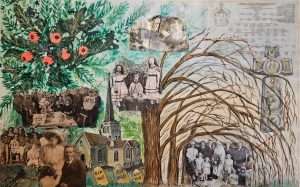
 The Yew tree led me down a fascinating pathway as I focused on learning about the Canadian Yew and its English counterpart this month. The ancient Yew Tree holds within its embrace a treasure trove of wisdom and symbolism. Its roots reach back to the days preceding the dinosaurs. Its branches stretch down (not up!) towards the future. Yews have learned the wisdom of survival through changing times and climates.
What is the Yew Tree?
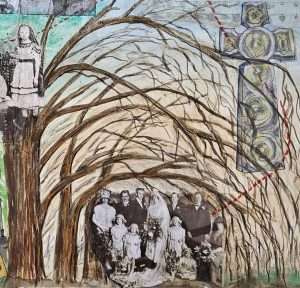
The Canada or American yew is a woody, needled evergreen shrub in the yew family (Taxaceae), native to central and eastern North America. It grows under the forest canopies of old cedars, maples, and firs. The English Yew (Taxus baccata) is older than the Canadian Yew, is a dense evergreen, branching tree, with an enormous trunk with thin, scaly, flaky, brown bark. It reaches up to 20m tall. It has short dark green, leathery, and narrow pointed leaves. Its branches bend back down to the ground and form new roots and new tree growth. Yew flowers are borne in separate male and female trees - a primitive feature in conifers. The interesting seeds are enclosed in a red, fleshy, berry-like coat known as an aril which is open at the tip, and not a cone like most conifers. Yews are often used as a hedging plant as they are dense, offering protection and nesting opportunities for birds who also eat their fruit.
Ancient Guardians of the Forest
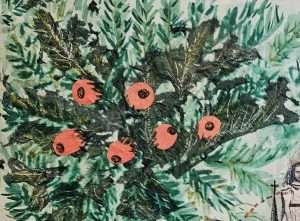
With their stoic presence, Yew trees have weathered countless storms and changing climatic and geologic conditions and witnessed the dance of civilizations. They have learned the wisdom of survival through change. Although this tree is toxic, the indigenous people knew of its healing properties and used it for infusions and poultices. A substance called paclitaxel derived from the cambium of Pacific yew trees was discovered by pharmaceutical companies and is used for infusions for cancer treatment. Indigenous people made hooks, bows, and arrows from the hardwood. Yew wood had a reputation for being indestructible. The English crafted longbows from this wood as it possessed immense strength and durability - it was also used in turnery to make tool handles.
A Tapestry of Myth and Symbolism
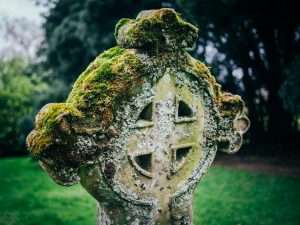
The Yew is steeped in mythology and symbolism. The Druids, Celts, and Christians wove tales of reverence and ritual around the Yew Tree. Legends hint at Pontius Pilate’s birth beneath its boughs and Celtic place names pay homage to its sacred presence. Churchyards are adorned with ancient Yew Trees, often older than the buildings themselves. These stand as a testament to its enduring symbolism of immortality and resurrection. The Yew's ability to rejuvenate by re-rooting branches that touch the soil to create a new trunk has led to this idea. Shakespeare mentions the Yew in his poetic verses in ‘Macbeth.’ Palm Sunday, rituals, and burials were part of the ancient Christian practices. The Yew Tree’s influence permeates history and culture, reminding us of our connection to the eternal cycle of community, life, and death.
Lessons from Nature’s Sage
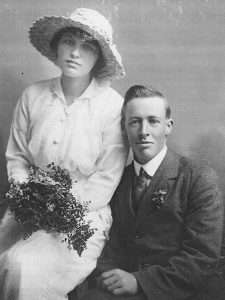
Although the yew is not mentioned by name in the Bible, its companion plants the cypress and juniper (sometimes referred to as mountain yew) are. God tells the people through the prophet Hosea, “He is like an evergreen cypress, from me comes your fruit.” God, the Eternal, is the rootstock of our Christian heritage. His lovingkindness is passed from generation to generation, as it is received by each person, it needs to be re-rooted and handed on.
The evergreen yew is a symbol of continuity from generation to generation. Our Christian heritage has come to us from our Judeo-Christian forebears. I prefer to use this verse, ‘Now when David had served God’s purpose in his generation, he fell asleep; he was buried with his ancestors and his body decayed.’ Acts 13:36 NIV.
The yew tree had to regenerate in the soil that surrounded it, not in some distant place. Unless a bird carried a seed that took root elsewhere, the yew created a new forest around itself. What wisdom can we learn from this ancient tree?
Roots of Continuity and Change
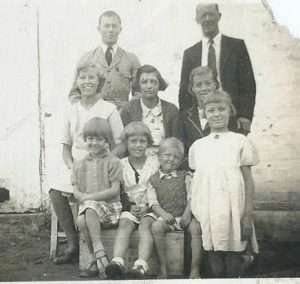
The Yew Tree, with its ability to regenerate from branches that bend to touch the soil, teaches us humility and resilience. It reminds us of the importance of passing down wisdom from generation to generation, of nurturing the roots of faith and resilience in our children and grandchildren. Like the Yew Tree, we must anchor ourselves in the soil of our heritage, drawing strength from the lessons of the past to navigate the uncertainties of the future. As we reflect on the Yew Tree’s timeless wisdom, we consider our role in the tapestry of human history. Just as the Yew Tree creates new forests around itself. We too must re-root ourselves in the soil of our children’s lives, imparting the lessons of our ancestors while embracing the innovations of the present. Like David, who served God’s purpose in his generation, let us strive to leave a legacy of goodness and wisdom for those who will come after us.
Questions to Ask Ourselves

We do not have to worry about living in the dinosaur’s world, survival is already embedded in our ‘reptile brain.’ What knowledge and skills did we learn from the fabric of our social history in this generation that is important for the next generation to take with them? Is there a period in history that we have idealized? Are there values and goodness we have seen lost, that if they returned, will enhance our world? Do we strive to do good, knowing that it is up to us to make a difference in the place where God has set us?
The Yew Tree stands as a symbol of continuity and change, reminding us of our place in the vast ocean of creation, time, and place. So, dear reader, what lessons will you draw from the timeless wisdom of the Yew Tree? Share your thoughts and reflections below and let us continue the conversation sparked by nature’s ancient guardian.
Explore more about environmental rejuvenation, spiritual harmony, and sustainable living in our journey towards a brighter, greener future. In the months ahead, I will share a poem, featuring a specific tree or plant, and a painting with you. Please subscribe to my monthly newsletter as I will feature the poem in it. Additionally, I can offer you a coloring poster to help you identify your needs, boundaries, weeds, and future seeds. This is a meditative exercise, giving you time to slow down and think about these things. Get this here.


0 Comments