FROM VICTIM TO VICTOR Learning, Overcoming rejection or Abandonment

By Deryn

Sep 15, 2019

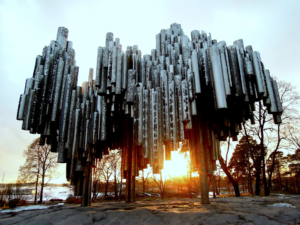
Sibelius monumnet Helsinki showing organ pipes that are tree trunks of the forest

Photo Pixabay, Sibelious Monument,

Music becomes a voice for change

I have long believed that the arts serve purposes far beyond decoration. A painting can tell a story. A poem can preserve a memory. A novel can give a forgotten person a voice. Drama and dance are transient vehicles for storytelling. And music? Music can bring people together.  have seen something of this for myself in my travels. I have stood before the monument to Jean Sibelius in Helsinki, Finland, and I have visited Estonia. Standing in those places, knowing something of their history, gives a different meaning to the music. You begin to understand that these were not simply composers writing beautiful melodies. In times of oppression and uncertainty, music can become a vessel carrying the identity of an entire people.

Music when a nation finds its voice

Consider Finland. For more than six hundred years, Finland was part of the Swedish realm. In 1809, it passed from Sweden to the Russian Empire and became an autonomous Grand Duchy. During the nineteenth century, a growing Finnish cultural movement sought to strengthen a distinct national identity. The Kalevala compiled from Finnish oral poetry, became an important expression of that identity. Artists, writers, and musicians began to give Finland a language of its own, not necessarily a political language, but a cultural one.

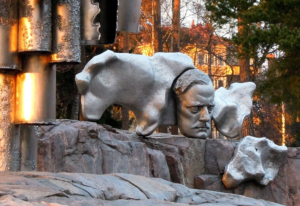
Sculpture of Sibelious Head, Helsinki

Photo Pixabay, Sibelious Monument

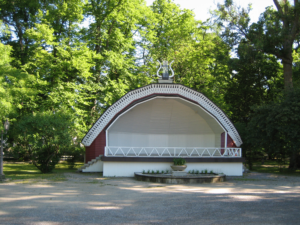
Then came Sibelius. In 1899, during a period of increasing Russian pressure and attempts at Russification, Sibelius composed the music that would become Finlandia It was originally part of a series of historical tableaux presented at the Press Celebrations in Helsinki. The final section, known as “Finland Awakes,” stirred something deep in the Finnish people. Finlandia became a symbol of Finnish nationalism. When I stood before the Sibelius monument, I wasn’t just viewing a memorial to a famous composer. It reminded me of what happens when art helps people remember their identity. Sibelius helped give Finland a sound, and sometimes people need a sound before finding a voice. Organ pipes represented the trees of the forest; forests go deep into the psyche of the Finnish people, a voice that resonated with them.Estonian Music Festival Stand

Estonia sang its way toward freedom

I experienced a similar feeling when I visited Estonia. Domination by powerful neighbors has marked Estonia’s history, and during the Soviet period, language and national identity were under pressure. Yet Estonia had an extraordinary cultural treasure: its singing tradition.

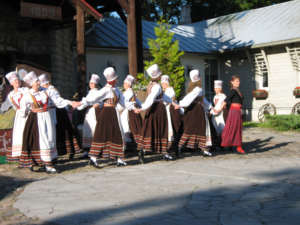
The Singing Revolution of the late 1980s demonstrated just how powerful that treasure could become. Hundreds of thousands of Estonians gathered at the Tallinn Song Festival Grounds and sang traditional and patriotic songs together. They sang Mu isamaa on minu arm, “Land of My Fathers, Land that I Love,” a song that had become deeply associated with Estonian identity. They also sang the patriotic songs of composer Alo Mattiisen.Music of Estonian Dancers

Estonian Folk Dancers, Video - Deryn van der Tang

This was nonviolence; they were not taking up arms, they were raising their voices. By 1989, the movement had grown into the remarkable Baltic Way, when people in Estonia, Latvia, and Lithuania joined hands in a human chain stretching across the three Baltic countries. Music had helped people remember they belonged to something larger than the political system that governed them.

The music that defied ruins

Then there is Sarajevo. During the terrible siege of Sarajevo in the 1990s, cellist Vedran Smailović became known as the “Cellist of Sarajevo.” After twenty-two people were killed while waiting for bread, Smailović returned to the devastated area and played Albinoni’s Adagio in G minor in their memory. Picture a city under attack. Amidst the broken buildings and people living in fear, a man sits with his cello and plays. The music could not stop the bombs, nor could it bring the dead back. But it declared something profound:

Beauty had not been destroyed. Human dignity had not been destroyed, and the human spirit had not been destroyed. That is the power of the arts.

Why do the arts matter?

When we talk about social change, we often think about politicians, protesters, legislation, and movements. And, of course, these matter. But underneath every movement is something deeper: a story about who we are and what we believe is worth preserving. Artists help us tell that story. A composer can give a nation a melody. Poets can preserve a language. Painters can capture a landscape that becomes part of a people’s memory. A storyteller can take the ordinary life of one family and reveal something universal about courage, suffering, and hope.

Perhaps that is why oppressive regimes have so often tried to control language, literature, music, and art. They understand something we sometimes forget: culture holds memory. And memory gives people identity.

The Bible tells us, “A word fitly spoken is like apples of gold in pictures of silver” (Proverbs 25:11).

Sometimes someone speaks, paints, sings, or writes that word.

The arts may not change the world overnight. Yet, they have the power to shift how people view the world. And once people see differently, they may begin to think differently, hope differently, and eventually act differently.

As I think about Finland, Estonia, and many other places I have traveled, I remember that the arts form a vital part of human society. They are part of our inheritance; they carry the stories of those who came before us. They inspire courage in those struggling today and plant seeds of hope for future generations. Perhaps that is why music has such extraordinary power.

A single voice may be silenced, a single instrument broken, yet a song alive in people’s hearts proves much harder to destroy.

And sometimes, when a people begin to sing together, the world begins to listen.

Join the discussion and follow me on these networks!

2018-06-27 01.31.20-1

At Santa Barbara

Last week we looked at the scenarios that led us to feeling rejected or abandoned. How do we take positive steps to take back our power and not feel the victim of someone else’s decisions? We may need to look back further than the current situation to find our healing.  Sometimes these feelings of abandonment start as a child. Were you ever in a supermarket or fair and you could not find your parents?  Did you parents neglect to spend a lot of time with you, leaving you to your own devises or a long line of child minders? 

Parents that were not available to you to nurture the bond that should be between parent and child. Perhaps your parents were divorced, and you could not bond with one or the other parent at a time when your greatest need was to feel safe and protected.  This may have led you into unhealthy attachments to caregivers or a romantic partner when you did find someone who took care of you. Instead of a relationship based on mutual care and love, you fell into a co-dependency role in an unhealthy relationship that led to divorce.

As a widow you may feel more intense grief at the death of your partner, feeling abandoned.  In the school grounds you felt abandoned and rejected when your best friend went off with someone else and you were shunned from the group. These are the roots that make us feel these emotions more intensely and if they have been a habitual pattern in your life may continue to plague you until they are recognized and dealt with.

So how do we get past this feeling of abandonment and rejection? First, you need to stop believing that you were not good enough or it was all your fault. (This could be from the childhood root).  Start to nurture yourself, where you felt you lacked, start making time to fill those places with self-love and care.  Take yourself out to the movies or a cup of coffee and cake, something that will feed your soul.  Listen to beautiful music, it washes your heart with tears.  Read good books, and if you are not a reader, listen to podcasts, but especially listen to the Word of God.  If you read the Psalms, you will find so many that meet your heart’s cry for answers. It is beautiful, when you come across a Psalm that speaks directly to your need, a message from God. Psalm 94:14 “The Lord will not reject his people; he will not abandon his special possession.” When we think we are unlovable and nobody will ever care for us again, remember that God who created you loves you and is there to help you through this dark place.

Don’t beat yourself up over the what ifs’ focus on replacing old memories with new memories and dreams of another future. Celebrate the good times and create an action plan for the future. I have found it to be much easier if you have a clean break. If you are divorced minimize contact to basics or via a third person.  Put emotional distance (physical environment too if possible) between you.  Heal your heart before dating again otherwise your same lack of confidence and unhealthy attachment pattern may rise up to sabotage you.

https://ntrelationships.com/single-again-dating-after-widowhood/

https://ntrelationships.com/single-again-dating-after-divorce/

Clear out the cupboards, get rid of items that bring back memories that hurt. I gave my wedding pictures to the children.  Or if widowed just making a special album or decorating s corner in your home to remember your departed where you can go when you want to remember. Make a space for your new future to emerge.

It is not helpful to follow your ex on social media or get the kids to spy on him. Keep taking back your own life by making new memories to replace the old hurtful ones. Visit new places, do things that you did not do with him. On a rough day, do hard physical exercise, walk run, play a sport. Scrub floors, whatever it takes to get it out of your system.

Spend time with friends or family, people who have your back and will listen to you. Join in community activities like hiking clubs, art or book clubs, try to find ones that are not couples orientated. Reinvent yourself – reassess your values and start doing the things that make you happy. Make some new life goals, set yourself challenges, learn new skills. Set goals that encompasses spiritual, mental, physical and emotional aspects so you grow in all areas.

There is a lot of learning to be done in this space, finding yourself again, and what you want for the future.  It is often helpful to make a vision board of what you would like your life to be like. This is all part of recovering your sense of self-worth – learn new skills so you can feel you have achieved something, that really gives you a boost. Continue to grow mentally, spiritually, and physically and you will see how they all work together to help you grow emotionally. Replace negative self-talk with positive affirmations and Bible verses that say you are beloved by God.  I took Art Classes and painted my heart out, just the positive feedback from another human being may be all you need to build your self confidence again.  Walk away from anyone who want to criticize and deride you and set boundaries on your own and other people’s behavior towards you.

Most of all learn to enjoy your own company while you are working through this loss, rather like a butterfly when it is in the chrysalis, quietly transforming on the inside, until you are ready to emerge in glorious technicolor.

2 Comments

  1. Yvonne De Martino

    This is an excellent read.
    Rejection is a terrible thing and can affect alot of decisions that we make in our lives, even into adult life.
    Knowing that our heavenly Father loves us as we are, takes a while to accept especially if when growing up we never had love from our earthly fathers.
    Once we realise God our heavenly Father excepts us no matter what we done wrong, how many mistakes we’ve made etc etc., it is a wonderful.
    At the end of the day, only God knows what we’ve been through. Thank God we don’t have to explain everything to Him, as He has been there from the moment we were conceived, even before that time.

    Reply
    • Deryn

      Thank you Yvonne for your feedback. I am glad you found the article helpful. Yes, God knows exactly what we have been through and wants to heal the broken places with His love, not His judgement!

      Reply

Submit a Comment

Your email address will not be published. Required fields are marked *

Join the discussion and follow me on these networks!

More From Crossing My Bridges

Sibelius monumnet Helsinki showing organ pipes that are tree trunks of the forest

Music becomes a voice for change

A single voice may be silenced, a single instrument broken, yet a song alive in people’s hearts proves much harder to destroy.
And sometimes, when a people begin to sing together, the world listens.

read more...
Man in long grass with dog

THE STORIES OF ORDINARY PEOPLE

What ordinary people’s stories reveal is that true greatness is more than just being recognized. Sometimes it is measured simply by faithfulness in persevering day after day through the grind.

read more...

Pin It on Pinterest

Share This