THE SACRED RHYTHMS

By Deryn

Mar 1, 2021

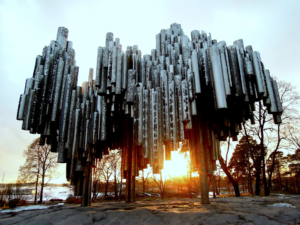
Sibelius monumnet Helsinki showing organ pipes that are tree trunks of the forest

Photo Pixabay, Sibelious Monument,

Music becomes a voice for change

I have long believed that the arts serve purposes far beyond decoration. A painting can tell a story. A poem can preserve a memory. A novel can give a forgotten person a voice. Drama and dance are transient vehicles for storytelling. And music? Music can bring people together.  have seen something of this for myself in my travels. I have stood before the monument to Jean Sibelius in Helsinki, Finland, and I have visited Estonia. Standing in those places, knowing something of their history, gives a different meaning to the music. You begin to understand that these were not simply composers writing beautiful melodies. In times of oppression and uncertainty, music can become a vessel carrying the identity of an entire people.

Music when a nation finds its voice

Consider Finland. For more than six hundred years, Finland was part of the Swedish realm. In 1809, it passed from Sweden to the Russian Empire and became an autonomous Grand Duchy. During the nineteenth century, a growing Finnish cultural movement sought to strengthen a distinct national identity. The Kalevala compiled from Finnish oral poetry, became an important expression of that identity. Artists, writers, and musicians began to give Finland a language of its own, not necessarily a political language, but a cultural one.

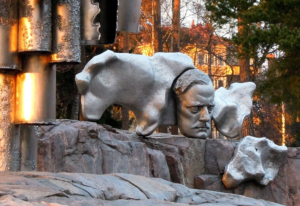
Sculpture of Sibelious Head, Helsinki

Photo Pixabay, Sibelious Monument

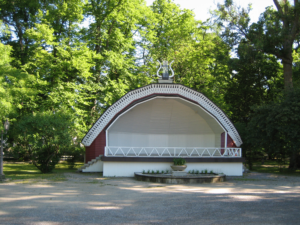
Then came Sibelius. In 1899, during a period of increasing Russian pressure and attempts at Russification, Sibelius composed the music that would become Finlandia It was originally part of a series of historical tableaux presented at the Press Celebrations in Helsinki. The final section, known as “Finland Awakes,” stirred something deep in the Finnish people. Finlandia became a symbol of Finnish nationalism. When I stood before the Sibelius monument, I wasn’t just viewing a memorial to a famous composer. It reminded me of what happens when art helps people remember their identity. Sibelius helped give Finland a sound, and sometimes people need a sound before finding a voice. Organ pipes represented the trees of the forest; forests go deep into the psyche of the Finnish people, a voice that resonated with them.Estonian Music Festival Stand

Estonia sang its way toward freedom

I experienced a similar feeling when I visited Estonia. Domination by powerful neighbors has marked Estonia’s history, and during the Soviet period, language and national identity were under pressure. Yet Estonia had an extraordinary cultural treasure: its singing tradition.

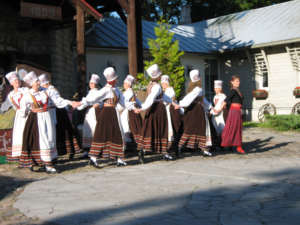
The Singing Revolution of the late 1980s demonstrated just how powerful that treasure could become. Hundreds of thousands of Estonians gathered at the Tallinn Song Festival Grounds and sang traditional and patriotic songs together. They sang Mu isamaa on minu arm, “Land of My Fathers, Land that I Love,” a song that had become deeply associated with Estonian identity. They also sang the patriotic songs of composer Alo Mattiisen.Music of Estonian Dancers

Estonian Folk Dancers, Video - Deryn van der Tang

This was nonviolence; they were not taking up arms, they were raising their voices. By 1989, the movement had grown into the remarkable Baltic Way, when people in Estonia, Latvia, and Lithuania joined hands in a human chain stretching across the three Baltic countries. Music had helped people remember they belonged to something larger than the political system that governed them.

The music that defied ruins

Then there is Sarajevo. During the terrible siege of Sarajevo in the 1990s, cellist Vedran Smailović became known as the “Cellist of Sarajevo.” After twenty-two people were killed while waiting for bread, Smailović returned to the devastated area and played Albinoni’s Adagio in G minor in their memory. Picture a city under attack. Amidst the broken buildings and people living in fear, a man sits with his cello and plays. The music could not stop the bombs, nor could it bring the dead back. But it declared something profound:

Beauty had not been destroyed. Human dignity had not been destroyed, and the human spirit had not been destroyed. That is the power of the arts.

Why do the arts matter?

When we talk about social change, we often think about politicians, protesters, legislation, and movements. And, of course, these matter. But underneath every movement is something deeper: a story about who we are and what we believe is worth preserving. Artists help us tell that story. A composer can give a nation a melody. Poets can preserve a language. Painters can capture a landscape that becomes part of a people’s memory. A storyteller can take the ordinary life of one family and reveal something universal about courage, suffering, and hope.

Perhaps that is why oppressive regimes have so often tried to control language, literature, music, and art. They understand something we sometimes forget: culture holds memory. And memory gives people identity.

The Bible tells us, “A word fitly spoken is like apples of gold in pictures of silver” (Proverbs 25:11).

Sometimes someone speaks, paints, sings, or writes that word.

The arts may not change the world overnight. Yet, they have the power to shift how people view the world. And once people see differently, they may begin to think differently, hope differently, and eventually act differently.

As I think about Finland, Estonia, and many other places I have traveled, I remember that the arts form a vital part of human society. They are part of our inheritance; they carry the stories of those who came before us. They inspire courage in those struggling today and plant seeds of hope for future generations. Perhaps that is why music has such extraordinary power.

A single voice may be silenced, a single instrument broken, yet a song alive in people’s hearts proves much harder to destroy.

And sometimes, when a people begin to sing together, the world begins to listen.

Join the discussion and follow me on these networks!

At the end of a long, cold winter, I am really looking forward to spring. I am dreaming of the flower beds popping with color as the spring bulbs push their way through the cold soil to warmer days, assuring me that Spring is finally here.

I was reminded on a webinar I was listening to how far we have come from living in the natural rhythms of life that the Creator made for our benefit. Our access to heat, food, lighting, and everything we really need to live comfortably in whatever weather or season we find ourselves has made us become like hamsters on a wheel, unable to get off getting exhausted in the process.

Our ancestors and native peoples used to live according to the seasons and rhythms of the days, the cycles of the sun and the moon, and the earth's seasons. My grandparents would live by the cycle of the day, getting up at sunrise, eating at noon, having a siesta in the heat of the day, then working until mid to late afternoon, when they would stop, visit with neighbors, and eat an early supper before locking themselves in for the night at 6.00 pm, they did not have TV or social media. They may have listened to the radio before settling down to sleep. Rising with the sun the next day.

On a visit to Arizona, I heard how the Diné people lived in harmony with nature and the seasons. The entrance of their hogans faces east so that they can greet the dawn and pray to their Creator. The Old Testament Israelite’s entrance of their Tabernacle also faced east; sunrise was the time for the morning sacrifice of sweet incense, which symbolized the people's prayers. Do we make time each morning to pray and listen to the voice of our Creator?

The hours between sunrise and sunset are the time to work and do the chores of the day. Time to prepare, sow seeds or create new ideas, nurture and produce and wait for the time to reap the rewards of our hard labor, or our monthly paycheck!

As the sun sinks in the west, it is time to close off the activities of the day. The Israelites had their evening sacrifice at sunset to thank the Lord for the day. This daily rhythm is one that we seem to have forgotten, working late into the night on projects or double shifts. Fetching and carrying children to extra activities, rushing into the grocery store to get supplies, we all do it. While in I was in Arizona I painted a synthesis of the harmony of living in the Sacred Rhythms, which I have posted here.

The kiss of the sun for pardon, The song of the birds for mirth, One is nearer God’s Heart in a garden Than anywhere else on earth. Dorothy Frances Gurney

My grandfather planted with the moon's seasons; there were times when he knew that it was better to plant than others. Some plants require a certain amount of moonlight, such as cherries, to grow optimally. The sea's tides are governed by the phases of the moon and the gravitational pull of the moon. Our moods can be affected by the moon, just as a woman’s monthly cycles affect her emotions.

"There is a season for everything under heaven" King Solomon wrote in Ecclesiates.  Spring as a time of birthing, renewal, and growth. Daffodils are one of the first bulbs to flower, and lambs are often a symbol of spring.

Summer is a time for youth, the growing pains of learning and working when our muscles and bodies are strong—a time to explore and tend to the land, family life and produce. Autumn is the time to harvest what we have produced. Our harvest may be bountiful or thin according to the effort we put in and the generosity of nature, and the seasonal rains. Winter is a time for rest and preparation for a new season as the year turns again. It can also symbolize old age and night, preparing our spirit to be released back to our Creator. I love the simplicity of the natural rhythms. A Diné Hogan has an exit on the north side which allows the departing spirit a way out of the hogan when someone dies.

I wonder what it would be like if we could live by the natural rhythms, our Creator gave us again? COVID has disrupted our normal way of life, so we have adapted by living even closer with technology sitting for hours at a time in front of our screens. Would it help if we were to become more in tune with our daily rhythms and need for relaxation and sleep and switch everything off at sunset? Or the monthly rhythms when maybe our moods are affected, and our energy levels are affected? Should our work reflect the season of life we find ourselves in, either in the annual or life cycle? Have we moved so far away from our Creator’s design for our lives?

Do you think we could ever get back to a place where we could live in harmony with nature, the seasons, and the Sacred Rhythms we were given? Do let me know what you think, I would be really interested to know.

1 Comment

  1. Betsy McPeak

    This is a beautiful call to live more in synch with Creation and its rhythms.
    My dad always planted his garden according to the Farmer’s Almanac, which I know now is based on the cycles of the moon.
    My husband and I have actually done a lot better with Covid, especially during the months he did not go into the office. We got up when our bodies naturally woke up, rather than the 5 a.m. alarm, and we went for a walk every morning Just letting out eyes “see” outdoors was wonderful. Seeing what plants were blooming and feeling the ground beneath our feet was connecting. The hardest part for me is to be in sync with the sunset, Covid or not, because I work way too much in the evening, rather than winding down in rhythm with the earth.

    Reply

Submit a Comment

Your email address will not be published. Required fields are marked *

Join the discussion and follow me on these networks!

More From Crossing My Bridges

Sibelius monumnet Helsinki showing organ pipes that are tree trunks of the forest

Music becomes a voice for change

A single voice may be silenced, a single instrument broken, yet a song alive in people’s hearts proves much harder to destroy.
And sometimes, when a people begin to sing together, the world listens.

read more...
Man in long grass with dog

THE STORIES OF ORDINARY PEOPLE

What ordinary people’s stories reveal is that true greatness is more than just being recognized. Sometimes it is measured simply by faithfulness in persevering day after day through the grind.

read more...

Pin It on Pinterest

Share This