Why Inflexible Doctrine Divides, and how Love can Bind

By Deryn

Aug 13, 2021

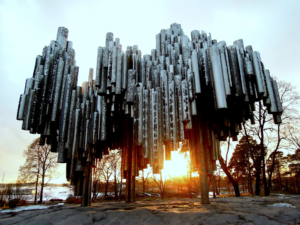
Sibelius monumnet Helsinki showing organ pipes that are tree trunks of the forest

Photo Pixabay, Sibelious Monument,

Music becomes a voice for change

I have long believed that the arts serve purposes far beyond decoration. A painting can tell a story. A poem can preserve a memory. A novel can give a forgotten person a voice. Drama and dance are transient vehicles for storytelling. And music? Music can bring people together.  have seen something of this for myself in my travels. I have stood before the monument to Jean Sibelius in Helsinki, Finland, and I have visited Estonia. Standing in those places, knowing something of their history, gives a different meaning to the music. You begin to understand that these were not simply composers writing beautiful melodies. In times of oppression and uncertainty, music can become a vessel carrying the identity of an entire people.

Music when a nation finds its voice

Consider Finland. For more than six hundred years, Finland was part of the Swedish realm. In 1809, it passed from Sweden to the Russian Empire and became an autonomous Grand Duchy. During the nineteenth century, a growing Finnish cultural movement sought to strengthen a distinct national identity. The Kalevala compiled from Finnish oral poetry, became an important expression of that identity. Artists, writers, and musicians began to give Finland a language of its own, not necessarily a political language, but a cultural one.

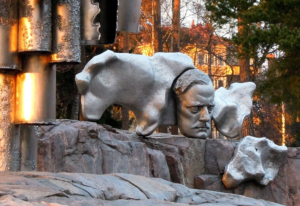
Sculpture of Sibelious Head, Helsinki

Photo Pixabay, Sibelious Monument

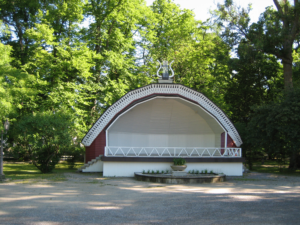
Then came Sibelius. In 1899, during a period of increasing Russian pressure and attempts at Russification, Sibelius composed the music that would become Finlandia It was originally part of a series of historical tableaux presented at the Press Celebrations in Helsinki. The final section, known as “Finland Awakes,” stirred something deep in the Finnish people. Finlandia became a symbol of Finnish nationalism. When I stood before the Sibelius monument, I wasn’t just viewing a memorial to a famous composer. It reminded me of what happens when art helps people remember their identity. Sibelius helped give Finland a sound, and sometimes people need a sound before finding a voice. Organ pipes represented the trees of the forest; forests go deep into the psyche of the Finnish people, a voice that resonated with them.Estonian Music Festival Stand

Estonia sang its way toward freedom

I experienced a similar feeling when I visited Estonia. Domination by powerful neighbors has marked Estonia’s history, and during the Soviet period, language and national identity were under pressure. Yet Estonia had an extraordinary cultural treasure: its singing tradition.

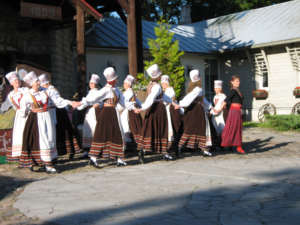
The Singing Revolution of the late 1980s demonstrated just how powerful that treasure could become. Hundreds of thousands of Estonians gathered at the Tallinn Song Festival Grounds and sang traditional and patriotic songs together. They sang Mu isamaa on minu arm, “Land of My Fathers, Land that I Love,” a song that had become deeply associated with Estonian identity. They also sang the patriotic songs of composer Alo Mattiisen.Music of Estonian Dancers

Estonian Folk Dancers, Video - Deryn van der Tang

This was nonviolence; they were not taking up arms, they were raising their voices. By 1989, the movement had grown into the remarkable Baltic Way, when people in Estonia, Latvia, and Lithuania joined hands in a human chain stretching across the three Baltic countries. Music had helped people remember they belonged to something larger than the political system that governed them.

The music that defied ruins

Then there is Sarajevo. During the terrible siege of Sarajevo in the 1990s, cellist Vedran Smailović became known as the “Cellist of Sarajevo.” After twenty-two people were killed while waiting for bread, Smailović returned to the devastated area and played Albinoni’s Adagio in G minor in their memory. Picture a city under attack. Amidst the broken buildings and people living in fear, a man sits with his cello and plays. The music could not stop the bombs, nor could it bring the dead back. But it declared something profound:

Beauty had not been destroyed. Human dignity had not been destroyed, and the human spirit had not been destroyed. That is the power of the arts.

Why do the arts matter?

When we talk about social change, we often think about politicians, protesters, legislation, and movements. And, of course, these matter. But underneath every movement is something deeper: a story about who we are and what we believe is worth preserving. Artists help us tell that story. A composer can give a nation a melody. Poets can preserve a language. Painters can capture a landscape that becomes part of a people’s memory. A storyteller can take the ordinary life of one family and reveal something universal about courage, suffering, and hope.

Perhaps that is why oppressive regimes have so often tried to control language, literature, music, and art. They understand something we sometimes forget: culture holds memory. And memory gives people identity.

The Bible tells us, “A word fitly spoken is like apples of gold in pictures of silver” (Proverbs 25:11).

Sometimes someone speaks, paints, sings, or writes that word.

The arts may not change the world overnight. Yet, they have the power to shift how people view the world. And once people see differently, they may begin to think differently, hope differently, and eventually act differently.

As I think about Finland, Estonia, and many other places I have traveled, I remember that the arts form a vital part of human society. They are part of our inheritance; they carry the stories of those who came before us. They inspire courage in those struggling today and plant seeds of hope for future generations. Perhaps that is why music has such extraordinary power.

A single voice may be silenced, a single instrument broken, yet a song alive in people’s hearts proves much harder to destroy.

And sometimes, when a people begin to sing together, the world begins to listen.

Join the discussion and follow me on these networks!

St Paul's, Bedford

I have long pondered why there is so much division in religion and in Christianity in particular, when everyone reads the same Bible. A lot of it is what doctrines people believe about the Scriptures, whether they are divinely inspired or a set of inerrant laws to be followed. Parables and stories are often used to explain tricky questions, so here is a little story to illustrate what I mean.

THE PARABLE OF THE EAGLE AND THE OAK TREE

COMMUNION OF THE SAINTS

There was an old oak tree that grew on the boundary of the churchyard and a field. The oak tree had been standing for centuries; in fact, it was standing when George Whitefield had preached in this very field on one of his itinerant journeys to preach to groups of working-class people. The oak tree grew strong and tall, its roots deeply embedded in the soil, drawing nutrients up into the branches and grounding it to endure the wind and storms that beat upon it every year.

St Paul's Square, Bedford

The church building with its weathered stone and square tower had stood from the Norman invasion. The bones of generations of people lay under the tilting gravestones in the churchyard. People who had lived loved and walked in the shade of the oak tree. They had sat in the church pews to learn about God.  Many changes occurred as who had stood in the pulpit, monks, and abbots as they taught their flock about God. Some people listened to John Bunyan, a Puritan and non-Conformist preacher, and others, John and Charles Wesley, who preached from this pulpit.

TRADITION

The sun filtered through the stained-glass windows onto the lectern inside the church.  It was in the form of a golden eagle with its wings outspread. On its wings rested the Word of God, the Bible. This had been updated with the times. It had once held parchment hand-scribed pages, faithfully copied by the monks. In 1611 it was replaced by the King James Bible, and since then, newer translations have been held on the eagle's outstretched wings.

Brass Eagle Lectern - photo Christies Catalogue

Outside sitting in the branches of the oak tree, were some birds. They chattered and quarreled over which bough to roost on. There were already several nests in the tree.

The golden eagle flew overhead. "This is my tree," he said to the birds, looking down," Any birds that hear me crying out and listen to the words I say are welcome to roost here. There are only two rules. One is to love me and the other is to love each other. My tree provides you with safety, and gives you the opportunites to look after each other. All you have to do is follow the instructions written in my book.”

THE WORD

Each flock of birds had its own copy of the book. Foreign birds had flown in from abroad, so their book was written in a different language, but the instructions meant the same. Other birds had different editions of the book - the words were not the same, but the directions of the golden eagle to love him and each other were the same. So whichever version of his book you read, the eagle had made sure that his message that he loved all birds was the same.

King James Bible 1629 - photo digital commons- Cedar University

The birds often met together to read the book and discuss what the words meant. They also loved to sing with the voices they had been given. Some sang with a lovely trill, others cawed or had a soft chirp, but the sound they made together was an excellent dawn chorus in praise of the golden eagle. They loved to do this, as this was one reason they decided to build their nests in the eagle’s tree.

DISPUTES OVER DOCTINE

Over time, some birds started picking the words in the book to pieces; they would sit on a branch and argue over what a particular word meant.

"Our book is the original and best book,” said the warblers. If someone did not agree with them, they pecked them and told them to go and sit on another branch.

man raising his right arm
Photo by Rene Asmussen on Pexels.com

The oak tree listened to the birds as they hopped from branch to branch, arguing over the meanings of the instructions. Those that sat on lower limbs would discuss what they understood about particular instructions. Each group started to chase away the birds that disagreed with their interpretation until there were different groups of birds on just about every branch of the tree, all with different opinions. While the birds argued over the exact details of what the eagle meant, they forgot about the two rules, loving the eagle, and loving each other.

Love the Lord your God with all your heart and with all your soul and with all your strength and with all your mind’; and, ‘Love your neighbor as yourself.’”

Luke 10:27

The eagle was most dismayed when he saw what was going on in the nests and branches. “They just don’t get it," he said to himself, “my instructions are not about the words and what they mean, they are about the actions, and how the birds must live.”

tilt shift photo of two white bird eggs on a nest
Photo by Mauriciooliveira109 on Pexels.com

CRISIS PROVIDES OPPORTUNITIES TO PRACTICE FAITH

The following spring was cold and bleak: weeks of rain making life miserable for the birds. The north winds blew in a severe storm. One dark night, lightning struck one of the ancient limbs of the oak tree; it was gnarled and weakened from the winter storms. The branch broke off with a thud knocking the birds' nests onto the ground, smashing eggs, and leaving the birds squawking in dismay.

Some birds on the unaffected side of the tree snuggled closer into their warm nests, ignoring the cries of dismay below them. "Silly birds, they should not have moved to that branch," they muttered to themselves as they kept their eggs warm and snuggled even deeper into their nest."

black leafless tree
Photo by eberhard grossgasteiger on Pexels.com

Other of the birds whose nests were safe shuffled around in their nests feeling a bit discomforted, but fluffed their wings and settled down again, "that's life, I guess you were just unlucky, not one of the elect." They blocked their ears to the cries of their brother birds.

The eagle flew past again, checking to see what would happen. Had the birds really taken to heart the instructions in his book?  "Yes, there was some movement down there."

LOVE IS AN ACTION

The swallow seeing so much mud around, said, "I can make a few houses in the eaves of the church building, just hold on a bit, while I get the mud and pack it," so off he went busying himself making as many nests as he could, inviting the other swallows to help him.  Soon there was a small colony of nests built under the eaves of the entrance porch of the church. The birds whose nests had been broken went searching for soft sheep's wool and plants to line their new mud homes so they could move in. As they thanked the swallows, the golden eagle alit on the oak tree and smiled. Some of the birds had understood his instructions. He then flew into the building and settled down again with his wings open, holding up the Word of God.

Swallows Nests
Swallows nests - photo Bird-B-gone , no copyright infringement intended

The oak tree continued to watch over new generations of birds, making their nests and people resting in its shade. The scar of where the branch broke off could still be seen as a big weal on its trunk, healed but making it vulnerable to rot. The golden eagle still sits with its outspread wings inviting people to read the instructions to love God and love their neighbor.

Even the sparrow has found a home, And the swallow a nest for herself, where she may lay her young— Even Your altars, O Lord of hosts, My King and my God.” Psalm 84:3

0 Comments

Submit a Comment

Your email address will not be published. Required fields are marked *

Join the discussion and follow me on these networks!

More From Crossing My Bridges

Sibelius monumnet Helsinki showing organ pipes that are tree trunks of the forest

Music becomes a voice for change

A single voice may be silenced, a single instrument broken, yet a song alive in people’s hearts proves much harder to destroy.
And sometimes, when a people begin to sing together, the world listens.

read more...
Man in long grass with dog

THE STORIES OF ORDINARY PEOPLE

What ordinary people’s stories reveal is that true greatness is more than just being recognized. Sometimes it is measured simply by faithfulness in persevering day after day through the grind.

read more...

Pin It on Pinterest

Share This