LEARNING TO BE CONTENT WHATEVER THE CIRCUMSTANCES

By Deryn

Feb 21, 2020

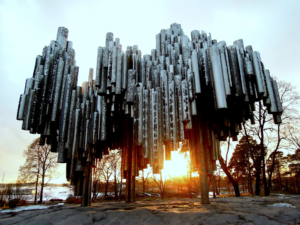
Sibelius monumnet Helsinki showing organ pipes that are tree trunks of the forest

Photo Pixabay, Sibelious Monument,

Music becomes a voice for change

I have long believed that the arts serve purposes far beyond decoration. A painting can tell a story. A poem can preserve a memory. A novel can give a forgotten person a voice. Drama and dance are transient vehicles for storytelling. And music? Music can bring people together.  have seen something of this for myself in my travels. I have stood before the monument to Jean Sibelius in Helsinki, Finland, and I have visited Estonia. Standing in those places, knowing something of their history, gives a different meaning to the music. You begin to understand that these were not simply composers writing beautiful melodies. In times of oppression and uncertainty, music can become a vessel carrying the identity of an entire people.

Music when a nation finds its voice

Consider Finland. For more than six hundred years, Finland was part of the Swedish realm. In 1809, it passed from Sweden to the Russian Empire and became an autonomous Grand Duchy. During the nineteenth century, a growing Finnish cultural movement sought to strengthen a distinct national identity. The Kalevala compiled from Finnish oral poetry, became an important expression of that identity. Artists, writers, and musicians began to give Finland a language of its own, not necessarily a political language, but a cultural one.

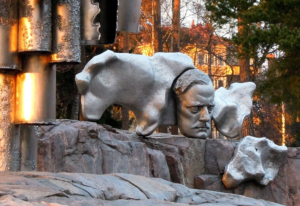
Sculpture of Sibelious Head, Helsinki

Photo Pixabay, Sibelious Monument

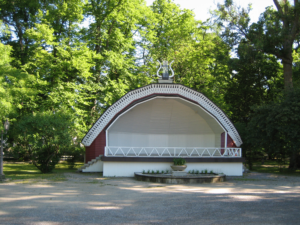
Then came Sibelius. In 1899, during a period of increasing Russian pressure and attempts at Russification, Sibelius composed the music that would become Finlandia It was originally part of a series of historical tableaux presented at the Press Celebrations in Helsinki. The final section, known as “Finland Awakes,” stirred something deep in the Finnish people. Finlandia became a symbol of Finnish nationalism. When I stood before the Sibelius monument, I wasn’t just viewing a memorial to a famous composer. It reminded me of what happens when art helps people remember their identity. Sibelius helped give Finland a sound, and sometimes people need a sound before finding a voice. Organ pipes represented the trees of the forest; forests go deep into the psyche of the Finnish people, a voice that resonated with them.Estonian Music Festival Stand

Estonia sang its way toward freedom

I experienced a similar feeling when I visited Estonia. Domination by powerful neighbors has marked Estonia’s history, and during the Soviet period, language and national identity were under pressure. Yet Estonia had an extraordinary cultural treasure: its singing tradition.

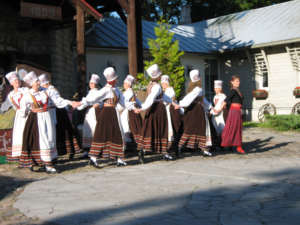
The Singing Revolution of the late 1980s demonstrated just how powerful that treasure could become. Hundreds of thousands of Estonians gathered at the Tallinn Song Festival Grounds and sang traditional and patriotic songs together. They sang Mu isamaa on minu arm, “Land of My Fathers, Land that I Love,” a song that had become deeply associated with Estonian identity. They also sang the patriotic songs of composer Alo Mattiisen.Music of Estonian Dancers

Estonian Folk Dancers, Video - Deryn van der Tang

This was nonviolence; they were not taking up arms, they were raising their voices. By 1989, the movement had grown into the remarkable Baltic Way, when people in Estonia, Latvia, and Lithuania joined hands in a human chain stretching across the three Baltic countries. Music had helped people remember they belonged to something larger than the political system that governed them.

The music that defied ruins

Then there is Sarajevo. During the terrible siege of Sarajevo in the 1990s, cellist Vedran Smailović became known as the “Cellist of Sarajevo.” After twenty-two people were killed while waiting for bread, Smailović returned to the devastated area and played Albinoni’s Adagio in G minor in their memory. Picture a city under attack. Amidst the broken buildings and people living in fear, a man sits with his cello and plays. The music could not stop the bombs, nor could it bring the dead back. But it declared something profound:

Beauty had not been destroyed. Human dignity had not been destroyed, and the human spirit had not been destroyed. That is the power of the arts.

Why do the arts matter?

When we talk about social change, we often think about politicians, protesters, legislation, and movements. And, of course, these matter. But underneath every movement is something deeper: a story about who we are and what we believe is worth preserving. Artists help us tell that story. A composer can give a nation a melody. Poets can preserve a language. Painters can capture a landscape that becomes part of a people’s memory. A storyteller can take the ordinary life of one family and reveal something universal about courage, suffering, and hope.

Perhaps that is why oppressive regimes have so often tried to control language, literature, music, and art. They understand something we sometimes forget: culture holds memory. And memory gives people identity.

The Bible tells us, “A word fitly spoken is like apples of gold in pictures of silver” (Proverbs 25:11).

Sometimes someone speaks, paints, sings, or writes that word.

The arts may not change the world overnight. Yet, they have the power to shift how people view the world. And once people see differently, they may begin to think differently, hope differently, and eventually act differently.

As I think about Finland, Estonia, and many other places I have traveled, I remember that the arts form a vital part of human society. They are part of our inheritance; they carry the stories of those who came before us. They inspire courage in those struggling today and plant seeds of hope for future generations. Perhaps that is why music has such extraordinary power.

A single voice may be silenced, a single instrument broken, yet a song alive in people’s hearts proves much harder to destroy.

And sometimes, when a people begin to sing together, the world begins to listen.

Join the discussion and follow me on these networks!


Reflections on solitary outings and activities, by Denise McLaughlan

Being single again has many challenges and loneliness is one of them.  Denise shares her story with how she has been able to be content within her circumstances. This has been a day by day walk.

These days I am constantly aware of the merits of going -it-alone! Being an extrovert and socially inclined, the prospect of outings and get-togethers used to be paramount. I could even admit to a touch of Fomo- fear of missing out, but lately I have tempered this inclination. Maybe due to the ageing process- which I tend to ignore!

 I am discovering the pleasure of pursuing passions for certain things like country drives - I call it Small-town Hunting, I love weekend getaways or just sitting alone in lovely surroundings. This could be a coffee-shop with atmosphere, a tea-garden - anywhere I can sit, read, or write in my journal, also to take photos of old buildings/landscapes. It seems to me that the only requisites are a pretty, vintage-like or close-to- nature setting, a book, a pen and the money for a coffee or light meal...Sometimes I take my own picnic. I am discovering that much pleasure is to be found in simple things that need not cost much money.

My weekend often includes just one outing or pleasurable activity to keep me content  - to feel less lonely .An example would be my drive one Saturday morning to Franschhoek, a very pretty historical town with a decidedly French atmosphere -mainly to go and listen to a well-known journalist/political commentator at the Huguenot Association of S A where I could also find out more about my Cilliers family research.

Beforehand I enjoyed a coffee milkshake at an open-air cafe, then strolled through a market, where I bought a blackboard and chalk, a new straw hat for the summer and six plants for my new-found interest in my garden, all at a very reasonable price! The trick is to focus on places where you can indulge in your own interests or passions – whatever they may be.

I thoroughly enjoyed mingling with other descendants of the French Huguenots, listening to the topic of the day and actually finding out some vital information about my paternal grandmother!

On the other hand, I have started cherishing time spent in my home and garden. My various activities include reading, knitting, creating little corners of interest or displays such as my travel corner in the entrance hall complete with a globe, vintage suitcase and old-fashioned picnic basket plus travel magazines!  I have also arranged a bookcase with comfy chair and little table for tea as a reading corner with invariably the French doors open for the summer breeze and a view of my little side veranda. To enjoy time alone I find I must create the setting and get the right atmosphere – which could be a simple as a little glass container with a few small flowers from my garden, maybe a candle and the inevitable cup of tea- definitely in a pretty porcelain cup !

Then of course there is my hobby of adult colouring books where I can indulge in my love of color and creativity... I already own ten such books.   When one lives alone (and originally this was not by choice), you can eventually learn to enjoy the companionship of a pet- and my white cat Saphera purrs happily when she tentatively creeps onto  my lap while I knit or write or colour in. Who can resist such closeness?

Another source of stimulation and enjoyment is my creating PowerPoint Collages or cards - often for someone’s birthday using some of my many photographs. If permitted I share them on Facebook - another nice-to-do thing. That is to say if one has embraced new technology- which I would not want to be without now.

I am deeply grateful that I found it in myself to be on my own and not only to keep productively busy but also to be truly satisfied and content with who I am and where I am at. I am striving to have more time quiet time, in my case with my Lord Jesus, but could be spiritual awareness for someone else. I know that my abundance comes from Him.

More and more I am choosing to spend time alone and enjoying the freedom and choices that living alone gives one, therefore still maintaining a festive outlook on living alone!!

Paul said he had learned to be content whatever the circumstances, I think learning was the operative word. It is a process, and Denise has clearly outlined how she went about being content as a single person. What are you doing to learn contentment in your circumstances? We would be really happy to share your thoughts on rebuilding a contented single life.

0 Comments

Submit a Comment

Your email address will not be published. Required fields are marked *

Join the discussion and follow me on these networks!

More From Crossing My Bridges

Sibelius monumnet Helsinki showing organ pipes that are tree trunks of the forest

Music becomes a voice for change

A single voice may be silenced, a single instrument broken, yet a song alive in people’s hearts proves much harder to destroy.
And sometimes, when a people begin to sing together, the world listens.

read more...
Man in long grass with dog

THE STORIES OF ORDINARY PEOPLE

What ordinary people’s stories reveal is that true greatness is more than just being recognized. Sometimes it is measured simply by faithfulness in persevering day after day through the grind.

read more...

Pin It on Pinterest

Share This