TRANSFORMING THE BRIDE

By Deryn

Jan 25, 2020

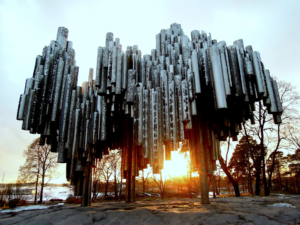
Sibelius monumnet Helsinki showing organ pipes that are tree trunks of the forest

Photo Pixabay, Sibelious Monument,

Music becomes a voice for change

I have long believed that the arts serve purposes far beyond decoration. A painting can tell a story. A poem can preserve a memory. A novel can give a forgotten person a voice. Drama and dance are transient vehicles for storytelling. And music? Music can bring people together.  have seen something of this for myself in my travels. I have stood before the monument to Jean Sibelius in Helsinki, Finland, and I have visited Estonia. Standing in those places, knowing something of their history, gives a different meaning to the music. You begin to understand that these were not simply composers writing beautiful melodies. In times of oppression and uncertainty, music can become a vessel carrying the identity of an entire people.

Music when a nation finds its voice

Consider Finland. For more than six hundred years, Finland was part of the Swedish realm. In 1809, it passed from Sweden to the Russian Empire and became an autonomous Grand Duchy. During the nineteenth century, a growing Finnish cultural movement sought to strengthen a distinct national identity. The Kalevala compiled from Finnish oral poetry, became an important expression of that identity. Artists, writers, and musicians began to give Finland a language of its own, not necessarily a political language, but a cultural one.

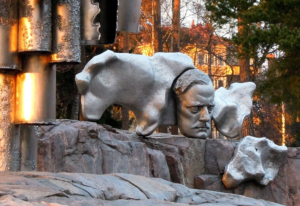
Sculpture of Sibelious Head, Helsinki

Photo Pixabay, Sibelious Monument

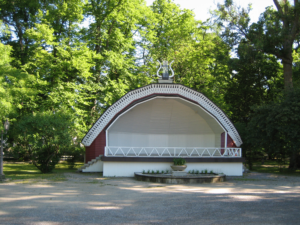
Then came Sibelius. In 1899, during a period of increasing Russian pressure and attempts at Russification, Sibelius composed the music that would become Finlandia It was originally part of a series of historical tableaux presented at the Press Celebrations in Helsinki. The final section, known as “Finland Awakes,” stirred something deep in the Finnish people. Finlandia became a symbol of Finnish nationalism. When I stood before the Sibelius monument, I wasn’t just viewing a memorial to a famous composer. It reminded me of what happens when art helps people remember their identity. Sibelius helped give Finland a sound, and sometimes people need a sound before finding a voice. Organ pipes represented the trees of the forest; forests go deep into the psyche of the Finnish people, a voice that resonated with them.Estonian Music Festival Stand

Estonia sang its way toward freedom

I experienced a similar feeling when I visited Estonia. Domination by powerful neighbors has marked Estonia’s history, and during the Soviet period, language and national identity were under pressure. Yet Estonia had an extraordinary cultural treasure: its singing tradition.

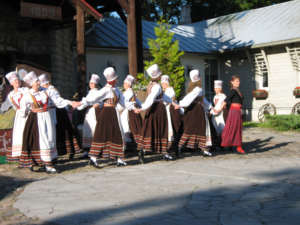
The Singing Revolution of the late 1980s demonstrated just how powerful that treasure could become. Hundreds of thousands of Estonians gathered at the Tallinn Song Festival Grounds and sang traditional and patriotic songs together. They sang Mu isamaa on minu arm, “Land of My Fathers, Land that I Love,” a song that had become deeply associated with Estonian identity. They also sang the patriotic songs of composer Alo Mattiisen.Music of Estonian Dancers

Estonian Folk Dancers, Video - Deryn van der Tang

This was nonviolence; they were not taking up arms, they were raising their voices. By 1989, the movement had grown into the remarkable Baltic Way, when people in Estonia, Latvia, and Lithuania joined hands in a human chain stretching across the three Baltic countries. Music had helped people remember they belonged to something larger than the political system that governed them.

The music that defied ruins

Then there is Sarajevo. During the terrible siege of Sarajevo in the 1990s, cellist Vedran Smailović became known as the “Cellist of Sarajevo.” After twenty-two people were killed while waiting for bread, Smailović returned to the devastated area and played Albinoni’s Adagio in G minor in their memory. Picture a city under attack. Amidst the broken buildings and people living in fear, a man sits with his cello and plays. The music could not stop the bombs, nor could it bring the dead back. But it declared something profound:

Beauty had not been destroyed. Human dignity had not been destroyed, and the human spirit had not been destroyed. That is the power of the arts.

Why do the arts matter?

When we talk about social change, we often think about politicians, protesters, legislation, and movements. And, of course, these matter. But underneath every movement is something deeper: a story about who we are and what we believe is worth preserving. Artists help us tell that story. A composer can give a nation a melody. Poets can preserve a language. Painters can capture a landscape that becomes part of a people’s memory. A storyteller can take the ordinary life of one family and reveal something universal about courage, suffering, and hope.

Perhaps that is why oppressive regimes have so often tried to control language, literature, music, and art. They understand something we sometimes forget: culture holds memory. And memory gives people identity.

The Bible tells us, “A word fitly spoken is like apples of gold in pictures of silver” (Proverbs 25:11).

Sometimes someone speaks, paints, sings, or writes that word.

The arts may not change the world overnight. Yet, they have the power to shift how people view the world. And once people see differently, they may begin to think differently, hope differently, and eventually act differently.

As I think about Finland, Estonia, and many other places I have traveled, I remember that the arts form a vital part of human society. They are part of our inheritance; they carry the stories of those who came before us. They inspire courage in those struggling today and plant seeds of hope for future generations. Perhaps that is why music has such extraordinary power.

A single voice may be silenced, a single instrument broken, yet a song alive in people’s hearts proves much harder to destroy.

And sometimes, when a people begin to sing together, the world begins to listen.

Join the discussion and follow me on these networks!

transformation2.jpgJesus used many parables and examples from nature during His time on earth. The book of Romans tells us that we are without excuse because since creation His attributes have been clearly seen and understood through what was created.  This has caused me to look at spiritual concepts and view them through nature and thus enrich my understanding of them.

Look at the Church, the Bride of Christ, we all understand that concept. We see the denominational diversity, divisions and competitiveness – how can we really become the one Bride of Christ?  Jesus said they shall be known because they love one another!  The conflicts and religious wars of history have shown that that hasn’t happened.  How can we accept one another’s differences and love one another at the same time? Let us look in creation for a metaphor and see if we can find an answer.

A tree has four components, a trunk, branches, leaves and roots. Without these it cannot live each being dependent on the other as a whole and the spirit (life-force) within that maintains its cycles.  If we look at each part and compare them to denominational or religious philosophies, we can see how much we depend on one another and therefore need each other to prepare the Bride of Christ.

The trunk, solid and immovable on what is right or wrong, black or white, no shades of grey. The Word of God is the Truth; we need to be reminded that this is so, that our focus is kept on the Triune God and that no other philosophy can woo us from this Truth. Trunks are covered with bark, that bark can be smooth or rough, striped, ringed or covered with thorns, and depending on how our Truth is projected or told to others can either protect or harm them. Fundamental Truth and belief systems.

The branches represent those who teach the Intellectual and Practical outworking of this central Truth.  Their programs reach out like the branches; they offer shade and shelter to the weary and to passersby. They reach out to causes like prisons, missions and good works.  They bear fruit; they feed the hungry, comfort the sorrowing.  They are always reaching out, even in winter when the branches are bare.

The leaves are seasonal and colorful. You know the wind is blowing by the rustling in the leaves. Jesus compared the Spirit to the wind; no one knows where it comes from or where it will go.  The leaves flutter and give trees their glorious colors.  In the Psalms it says the trees in the field will clap their hands in joy, charismatic movement.  We need the joyousness of the leaves to lift our souls in worship above the heaviness of life and to know when the Spirit is moving.  The leaves are there for a season, then drop to the ground where in due course they provide food for the roots.  The young leaves are then formed for the next season’s growth. There are seasonal patterns in our spirituality and belief systems.

We cannot see the roots, but we know they are there, they draw the nourishment and water up from the soil to feed the tree. There are people who set themselves apart to pray, those who withdraw from the world, contemplatives and mystics where meditation and prayer are central; the prayer warriors, monasteries, convents and communities.  Even if we do not see them, if these people stopped their function in the Church it would become very sick and maybe even die. We all need their prayer and deep connection to the Creator

Nature has given us a solution to the problem of religious and denominational difference and diversity.  We must accept the place God has assigned for each of us individually, whether it is the trunk, branches, leaves or roots and fulfil our function with all our hearts, minds and souls. This may be for a season or for a lifetime. We then must accept that God has assigned different people to different places and they are there to create balance, diversity, color and strength to His church so that the Church Universal can fulfil its function.

If we each maintain our own identity and function and accept everyone else’s identity and function as God given and as part of the whole, together we can transform the Bride of Christ because the Church will be known “because they love one another”. A tree will not survive if any one of the four components are missing so we need each other to grow in love and unity so we may be THE Bride and not many brides.

0 Comments

Submit a Comment

Your email address will not be published. Required fields are marked *

Join the discussion and follow me on these networks!

More From Crossing My Bridges

Sibelius monumnet Helsinki showing organ pipes that are tree trunks of the forest

Music becomes a voice for change

A single voice may be silenced, a single instrument broken, yet a song alive in people’s hearts proves much harder to destroy.
And sometimes, when a people begin to sing together, the world listens.

read more...
Man in long grass with dog

THE STORIES OF ORDINARY PEOPLE

What ordinary people’s stories reveal is that true greatness is more than just being recognized. Sometimes it is measured simply by faithfulness in persevering day after day through the grind.

read more...

Pin It on Pinterest

Share This